



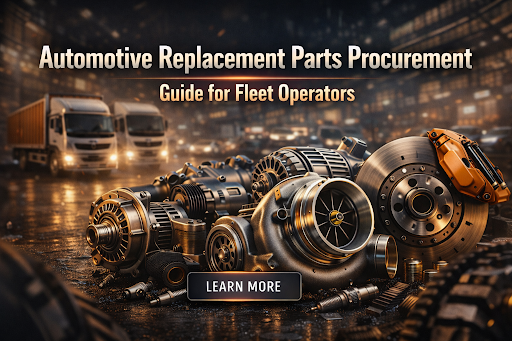
Fleet management is a dynamic process that requires fleet managers to continually strive to ensure maximum availability, cost control, and safety. One of the most important aspects of fleet management is the procurement of the right kind of automotive replacement parts at the right time. This is because improper procurement strategies can result in increased vehicle failures and maintenance costs. Proper procurement strategies can extend the life of the vehicle.
The following are some of the practical insights that fleet managers can use to simplify the process of auto parts procurement.
Understanding Fleet Requirements Before Procurement
Before purchasing any auto part, it’s essential to understand the requirements of your fleet. Every fleet differs according to the type of vehicles, their use, and the conditions under which they are used.
Start by assessing:
- The types of vehicles in your fleet (light commercial, heavy-duty, etc.)
- Average mileage of your vehicles
- Components that are prone to wear and tear
- Environmental factors (heat, dust, humidity)
For example, vehicles that are used under harsh conditions may need more frequent replacements of filters, brake pads, and shock absorbers. Therefore, if one understands these factors properly, it will be easier to forecast the requirements of the fleet rather than purchasing at the last moment.
Importance of Standardization Across the Fleet
The importance of standardization of parts used in vehicles can be understood by considering the following points. When there are various vehicles of different brands and models, it becomes complicated to deal with various parts. Therefore, it becomes easier to deal with vehicles that use the same type of parts.
Key benefits of standardization of vehicle parts include:
- Reduced inventory holding costs
- Easier scheduling of maintenance work
- Faster turnaround times for repairs
- Improved quality consistency
It is recommended that fleet operators try to match their vehicle choice and maintenance regime with standardized parts.
Evaluating Quality Over Cost
Although controlling costs is critical, using parts for their price alone may result in problems in the long term. Low-quality parts may require more frequent replacements.
When evaluating the quality of the part, the following aspects should be considered:
- Material quality and longevity
- Specifications of the manufacturer
- Availability of warranty and support services
- Supplier credibility
High-quality parts may have a higher initial price tag; however, they may provide better performance in the long term.
Building Strong Supplier Relationships
A reliable supply chain is vital for consistent procurement. Fleet operators should source from suppliers that understand the needs of the industry and can guarantee the timely availability of spare parts.
Key areas to look for in suppliers:
- A wide range of products that cover critical components
- Consistent quality assurance
- Clear pricing policy
- Reliable logistics
Maintaining long-term relationships with suppliers may result in more favorable pricing, priority service, and even customized solutions.
Inventory Planning and Demand Forecasting
Inventory management is a delicate balance between too much inventory and too little. Too much inventory may result in wasteful capital expenditure, while insufficient stock can delay repairs.
Best practices for fleet operators:
- Monitoring historical consumption trends
- Data-driven forecasting techniques
- Maintaining safety stock for critical spares
- Regularly auditing inventory
Technology-driven inventory management systems could be used to further improve this aspect.
Leveraging Data for Smarter Procurement
Data is an essential component of modern fleet management. Fleet managers can make informed decisions by using data to analyze maintenance needs and part replacements.
For instance,
- Parts that are often replaced could be procured in higher quantities.
- Seasonal trends could be taken into consideration.
- Data could be used to procure better alternatives.
In the middle of operations, having access to the right kind of automotive replacement parts at the right time becomes a competitive advantage rather than a necessity.
Ensuring Compatibility and Compliance
Using compatible automotive replacement parts is critical to fleet performance as well as compliance. Using incompatible parts could lead to mechanical failures as well as legal issues.
Always remember to ensure,
- Parts are compatible with the vehicles.
- Parts are compliant with industry safety regulations.
- Parts have adequate documentation.
This not only ensures the safety of your fleet but also ensures smooth audits and inspections.
Minimizing Downtime Through Efficient Procurement
Downtime is one of the factors that affects the profitability of a fleet. An efficient procurement process ensures that the fleet does not run out of spares.
The strategies that can be adopted to minimize downtime are as follows:
- Prepare a list of critical spares that are essential for the fleet.
- Develop processes to quickly reorder spares.
- Build partnerships with suppliers who offer fast turnaround of spares.
- Develop maintenance schedules.
Proactive procurement planning can greatly reduce unexpected breakdowns.
The Role of After-Sales Support
The process does not stop at purchasing the part. After-sales support is as important as any other factor to ensure reliability.
Fleet operators should look for:
- Technical assistance and guidance
- Easy return or replacement policies
- Access to service networks
- Training support for maintenance teams
This also increases confidence in the parts being used. Therefore, it can be said that strong after-sales support is crucial.
Making Procurement a Strategic Function
In many fleet businesses, procurement is a normal business practice. However, it has the potential to be a strategic advantage. If procurement is integrated strategically, it can help businesses become more efficient and cut costs.
This can be done in the following ways:
- Integrating procurement with fleet maintenance planning
- Utilizing technology in fleet procurement tracking and reporting
- Evaluating suppliers constantly
- Staying updated on the latest trends and innovations in the industry
If procurement is done strategically, it can help drive business performance.
Driving Long-Term Value Through Smarter Sourcing
A well-organized approach to procurement ensures that fleets are utilized, safe, and cost-efficient over time. Being able to consistently procure top-quality automotive replacement parts is an important factor that plays a crucial role in this process.
In today’s competitive environment, fleet operators are beginning to focus on reliability, efficiency, and cost management. This is where reliable solutions such as Tata Motors’ Durafit Parts come into play, providing reliable options that are consistent with industry needs.
In addition to that, integrating practices in fleet maintenance solutions, genuine parts, commercial vehicle parts, OEM quality parts, and truck parts online can also help in the improvement of efficiency in the procurement process.